
Ask a room full of cannabis consumers whether vaping is better for you than smoking and the room will agree with itself instantly. Almost nobody in that conversation has read a study.
The research that exists is more nuanced than the folklore, and mostly it lands in favour of vaporisers — with two or three honest caveats that deserve more airtime than they get. Here’s the evidence, laid out with sources so you can read the originals yourself.
The damage comes from combustion, not the plant
Light a joint and the burning tip runs at several hundred degrees. That cherry doesn’t just release cannabinoids — it drives an uncontrolled pyrolysis reaction that generates tar, carbon monoxide and a whole catalogue of by-products nobody would choose to inhale.
The science here is old and settled. In 1988, Tashkin’s team at UCLA reported in the New England Journal of Medicine that cannabis smokers deposited around three times more tar per puff than tobacco smokers and carried higher carboxyhaemoglobin levels — largely a consequence of how cannabis is consumed: deeper draws, longer breath-holds, no filter.
Chemical analysis has backed that up since. Canadian government researchers (Moir et al., 2008) pushed cannabis and tobacco cigarettes through smoking machines and measured toxicants including hydrogen cyanide, nitrogen oxides and aromatic amines at three to five times the concentrations found in tobacco smoke, with tar and particulate levels in the same ballpark.
That does not make a cannabis joint the equivalent of a cigarette — the epidemiology has never shown that, and long-term cannabis-only smokers fare considerably better than pack-a-day tobacco users. But “less bad than cigarettes” is a low bar to clear. Cough, phlegm, wheeze and chronic bronchitis are all well documented among regular smokers of the herb.
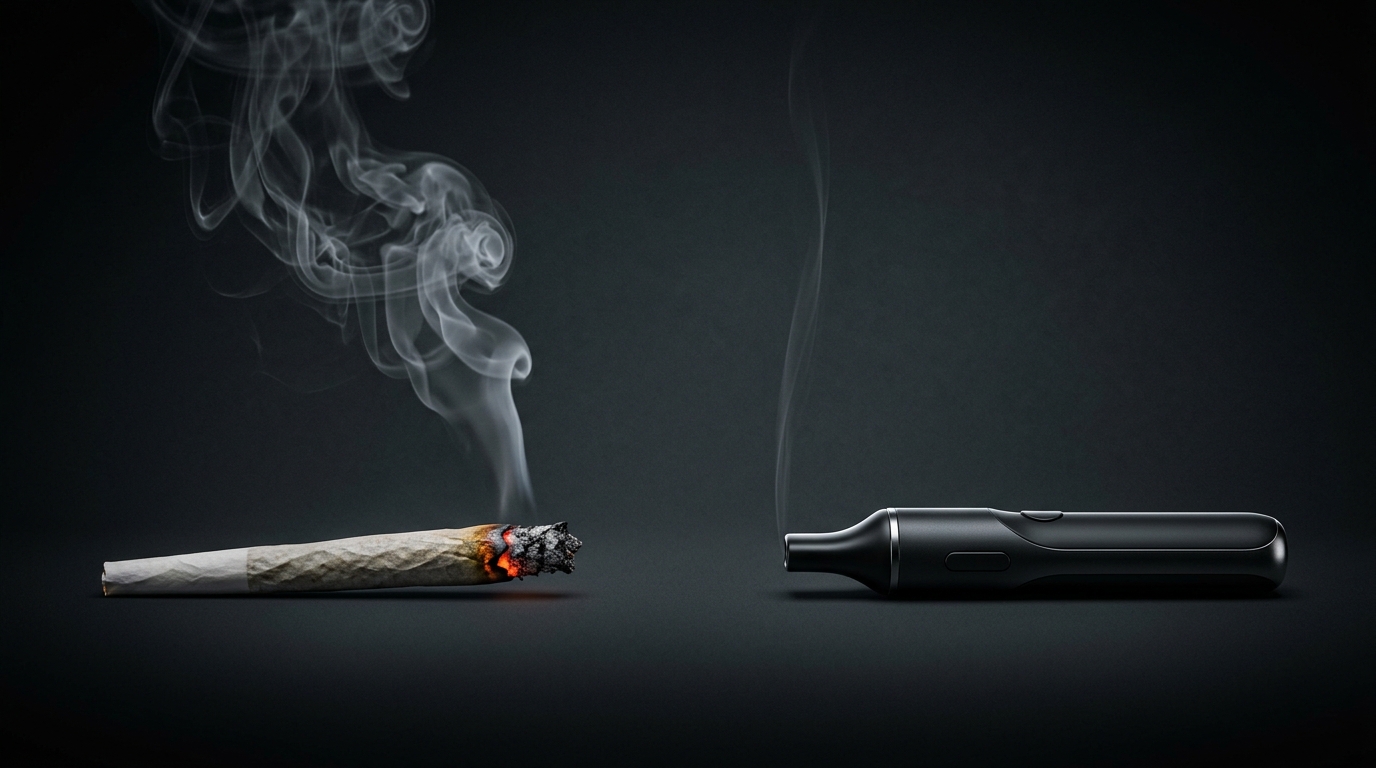
What changes when you take the flame away
A dry herb vaporiser removes combustion from the process altogether. The flower is heated to roughly 160–220°C — enough to volatilise cannabinoids and terpenes into an inhalable vapour, comfortably below the ignition point where the ugly chemistry starts.
The cleanest clinical test of the concept remains the 2007 pilot by Abrams and colleagues at UCSF.
Volunteers consumed cannabis either by smoking or through a Volcano vaporiser over six study days, and the results were striking: blood THC levels were essentially identical between the two methods, while carbon monoxide exposure fell sharply under vaporisation. Participants preferred the vaporiser by a wide margin. Same cannabinoids, a fraction of the combustion gases.
What happens to people who actually switch
Lab measurements are one thing; lungs are another. The user data points the same direction.
A large internet survey published in the Harm Reduction Journal in 2007 (Barnwell & Earleywine) found vaporiser users reported significantly fewer respiratory symptoms than smokers, even after adjusting for age, sex, cigarette use and volume of cannabis consumed. The gap widened the more cannabis someone used — which is precisely what you’d expect if combustion rather than cannabis is doing the respiratory damage.
A small follow-up trial went further: smokers with existing respiratory symptoms switched to a vaporiser for one month and showed measurable improvements in both reported symptoms and forced vital capacity within the 30 days. A 2015 review in the Canadian Journal of Respiratory Therapy surveyed the early literature and reached the same conclusion — vaporised cannabis appears to carry lower respiratory risk than smoked.
Medical users have voted with their devices, too. In a survey of Canadian medical cannabis patients, vaporisers had overtaken the joint as the most common consumption method, with harm reduction cited as the main motivation — and vaporiser users again reported less cough, phlegm and chest tightness.
The caveats that rarely make the headlines
Now the honest part.
Vapour delivers more than you expect. A 2018 crossover trial from Johns Hopkins (Spindle et al., JAMA Network Open) gave infrequent users identical THC doses smoked and vaporised. The vaporised dose produced stronger subjective effects and higher blood THC — including more anxiety and paranoia at the higher strength. Vaporisers waste less THC to the flame, so the same flower hits harder. Anyone switching should start with a smaller dose than smoker’s instinct suggests.
“Vaping” covers two very different things. The 2019 EVALI outbreak of severe lung injuries in the US was tied overwhelmingly to illicit THC oil cartridges thickened with vitamin E acetate — not to dry herb devices heating actual flower. Blurring the two has done genuine damage to public understanding. A dry herb vaporiser loaded with ground flower is a fundamentally different product from a black-market distillate cart.
Lower risk is not zero risk. Dry herb vaporisers haven’t been mainstream long enough for a 30-year cohort study to exist, and inhaling any hot vapour is unlikely to be entirely harmless. The defensible claim — the one researchers themselves use, as in this 2022 commentary — is harm reduction, not harm elimination.
Where this leaves the everyday consumer
For anyone who consumes cannabis by inhalation and intends to carry on, the direction of the evidence is consistent: removing the flame strips out most of the compounds behind the cough, the phlegm and the long-term respiratory toll, while delivering cannabinoids at least as efficiently — probably more so.
The old objections of cost and fiddliness have thinned out too. Manual devices such as the DynaVap sit at modest prices, and even the flagship desktop units from Storz & Bickel have drifted well down from their peaks. The practical guidance from the pharmacology never changes: begin at a lower temperature and a smaller dose than you think you need, then work up slowly.
Twenty years ago vaporisers were a curiosity in an academic photograph. Today they’re the single most evidence-backed harm reduction step available to someone who inhales their cannabis. That’s not marketing — it’s what the studies, read properly, actually show.
References
- Wu TC, Tashkin DP, et al. Pulmonary hazards of smoking marijuana as compared with tobacco. N Engl J Med. 1988.
- Moir D, et al. A comparison of mainstream and sidestream marijuana and tobacco cigarette smoke produced under two machine smoking conditions. Chem Res Toxicol. 2008.
- Abrams DI, et al. Vaporization as a smokeless cannabis delivery system: a pilot study. Clin Pharmacol Ther. 2007.
- Barnwell S, Earleywine M. Decreased respiratory symptoms in cannabis users who vaporize. Harm Reduct J. 2007.
- Van Dam NT, Earleywine M. Pulmonary function in cannabis users. Int J Drug Policy. 2010.
- Loflin M, Earleywine M. No smoke, no fire: what the initial literature suggests regarding vapourized cannabis and respiratory risk. Can J Respir Ther. 2015.
- Shiplo S, et al. Medical cannabis use in Canada: vapourization and modes of delivery. Harm Reduct J. 2016.
- Spindle TR, et al. Acute pharmacokinetic and subjective effects of smoked and vaporized cannabis. JAMA Netw Open. 2018.
- Chaiton M, et al. Vaping cannabis: harm reduction or harm production? Commentary. 2022.