

You remember the first time you hit a quality THC vape. That wave of relaxation. The euphoria. Maybe you giggled at nothing for twenty minutes.
Now? You’re three hits deep and barely feeling it.
Welcome to tolerance — the silent killer of good highs. And if you’re vaping THC regularly, it’s happening to you faster than you think.
Here’s what’s actually going on inside your brain, why vapes accelerate the process, and what the science says about resetting your system without taking a month off.
What Actually Happens When You Build THC Tolerance
Your brain doesn’t like being flooded with the same chemical repeatedly. It adapts. And when it comes to THC, that adaptation happens through a process called CB1 receptor downregulation.
Here’s the simplified version:
THC works by binding to cannabinoid receptors in your brain—primarily CB1 receptors. These receptors are responsible for the psychoactive effects: the high, the relaxation, the altered perception.
When you use THC regularly, your brain responds by doing two things. First, it reduces the number of CB1 receptors available on cell surfaces—a process called internalization. Second, the remaining receptors become less sensitive to THC.
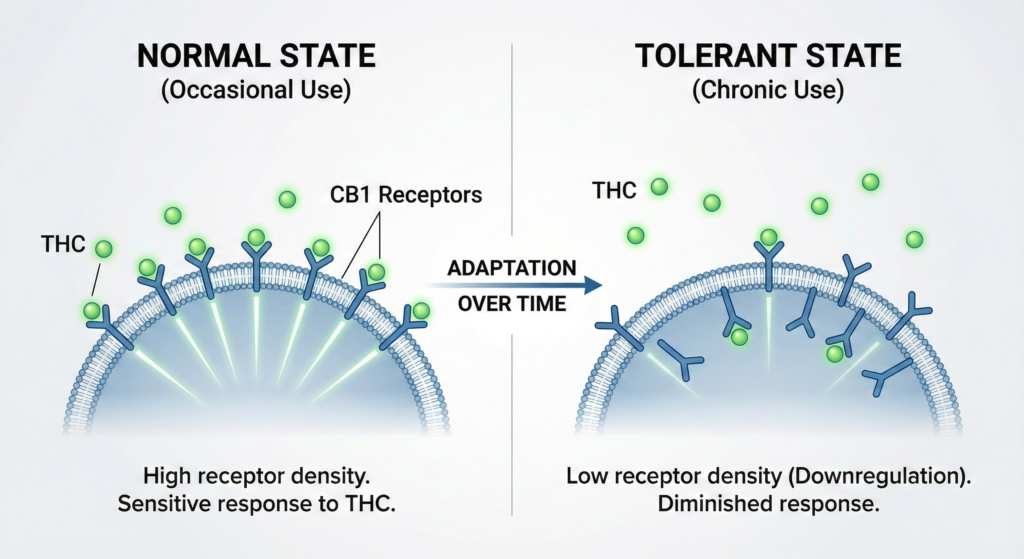
The result? You need more THC to achieve the same effect. And the cycle continues.
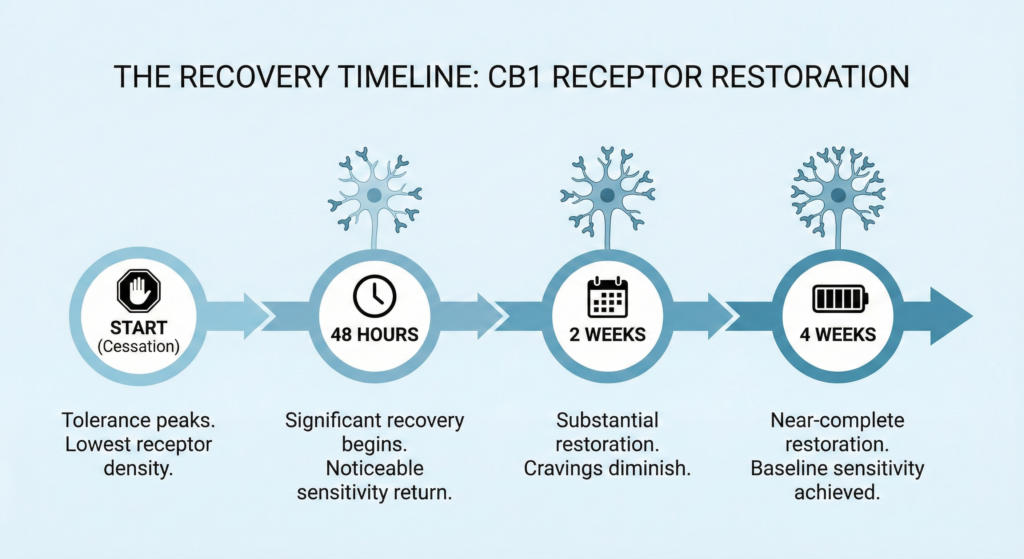
A 2012 study published in Molecular Psychiatry found that chronic cannabis users had approximately 20% fewer CB1 receptors in certain brain regions compared to non-users. The good news? Those same receptors began recovering within just two days of abstinence, with near-complete restoration after four weeks.
Why THC Vapes Build Tolerance Faster Than Flower
If you’ve switched from smoking flower to vaping concentrates, you may have noticed your tolerance climbing faster than before. This isn’t coincidental—it’s chemistry.
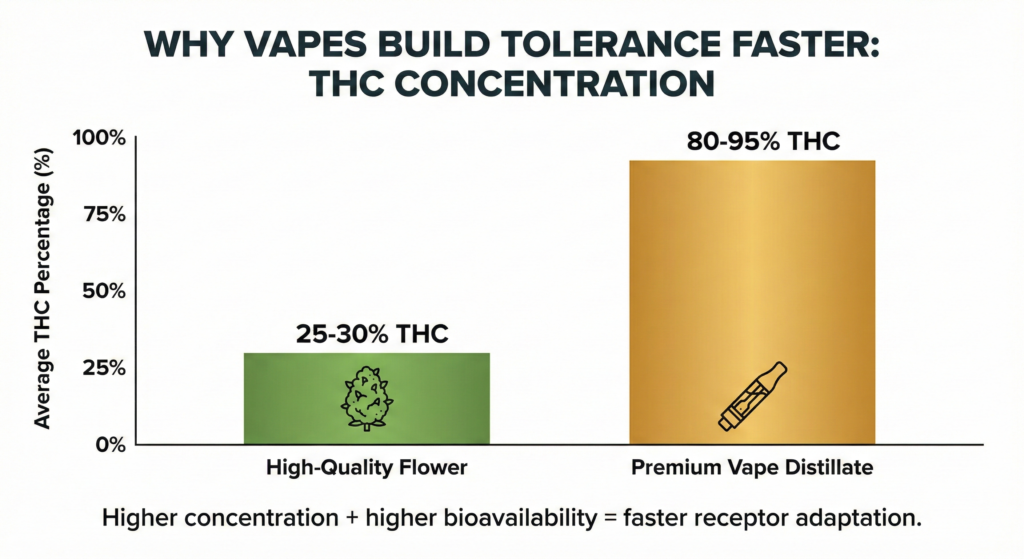
THC concentration matters. Premium THC vape pens typically contain 80-95% THC distillate. Compare that to high-quality flower, which usually tops out around 25-30% THC. You’re delivering significantly more THC per inhalation.
Bioavailability is higher. Vaporization is more efficient than combustion. Studies suggest that vaping delivers THC to your bloodstream more completely, meaning more of what you inhale actually reaches your brain.
Convenience increases frequency. Let’s be honest—vapes are easy. No grinding, no rolling, no lingering smell. That convenience often translates to more frequent use throughout the day, compounding the tolerance effect.
This isn’t an argument against vaping. The cleaner delivery, precise dosing, and discretion make vapes superior for most users. But understanding why tolerance builds faster helps you manage it proactively.
The Signs Your Tolerance Has Become Out of Control
Tolerance creeps up gradually, so it’s easy to miss until you’re deep in it. Watch for these signals:
You’re taking multiple hits to feel anything. If one or two pulls used to do the job and now you’re at five or six, your receptors are speaking.
The high feels “flat.” You’re technically high, but the magic is gone. No euphoria, no creativity boost—just a vague heaviness.
Duration has shortened dramatically. Your high used to last hours. Now it fades within 45 minutes.
You’re going through cartridges faster than ever. Track your consumption. If a cartridge that lasted two weeks now barely survives five days, that’s tolerance in action.
You’ve forgotten what being sober feels like. This one’s psychological, but important. If you can’t remember the last time you went a full day without vaping, your baseline has shifted.
The Science of Resetting: What Actually Works
Now for the part you came for. How do you get back to those one-hit-wonder days without suffering through weeks of abstinence?
Option 1: The Full Tolerance Break (T-Break)
Duration: 2-4 weeks
Effectiveness: Maximum
Complete abstinence remains the gold standard. Research shows CB1 receptors begin recovering within 48 hours of cessation, with significant restoration occurring by week two. By week four, most users report receptor density returning to near-baseline levels.
The challenge? It’s difficult, especially if you use THC for sleep, anxiety, or chronic pain. Cold turkey isn’t realistic for everyone.
Option 2: The Strategic Micro-Break
Duration: 48-72 hours
Effectiveness: Moderate but noticeable
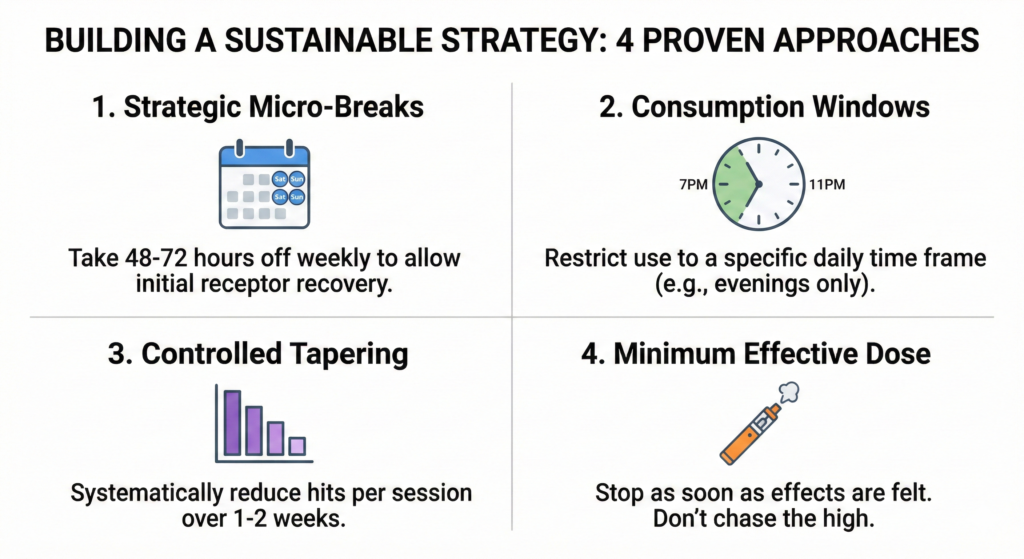
Can’t commit to a month? Even a weekend off makes a measurable difference. Those first 48 hours are when the most dramatic receptor recovery occurs. A Friday-to-Monday break can noticeably reduce your tolerance without disrupting your life.
Pro tip: Schedule your micro-breaks strategically. Plan them around weekends when you’re busy with activities that don’t trigger your usual vaping habits.
Option 3: The Controlled Taper
Duration: 1-2 weeks
Effectiveness: Moderate
Rather than stopping entirely, systematically reduce your consumption. If you’re currently taking six hits per session, drop to four. After a few days, drop to two. This allows partial receptor recovery while maintaining some THC in your system.
This approach works particularly well for medical users who can’t afford complete breaks.
Option 4: The Consumption Window Strategy
Duration: Ongoing
Effectiveness: Preventive
This isn’t a reset—it’s a lifestyle adjustment that prevents tolerance from building in the first place. Restrict your THC use to a specific time window each day, such as evenings only after 7 PM.
The extended daily break (in this case, roughly 20+ hours) allows partial receptor recovery before your next session. Users who adopt this approach report maintaining sensitivity long-term without ever needing a full T-break.
Optimizing Your Reset: Evidence-Based Booster
While taking a break, certain practices can accelerate receptor recovery:
Exercise. THC is fat-soluble and stored in adipose tissue. Cardiovascular exercise mobilizes fat stores and may help clear residual THC from your system faster. A 2014 study in Drug and Alcohol Dependence found that exercise increased blood THC levels temporarily (as it’s released from fat), suggesting active clearance.
Hydration and nutrition. Your endocannabinoid system functions optimally when your body is well-nourished. Omega-3 fatty acids, in particular, are precursors to endocannabinoids and support receptor health.
Quality sleep. Sleep is when your brain does its housekeeping. Receptor regulation and neural plasticity are enhanced during deep sleep cycles. If you’re taking a break, prioritize 7-9 hours per night.
CBD supplementation. Here’s an interesting hack: CBD may help modulate CB1 receptor function. While it doesn’t bind directly to CB1 like THC, research suggests CBD can influence receptor density and sensitivity. Some users report that using CBD during a T-break helps manage cravings while potentially supporting receptor recovery.
What to Expect When You Return
After a successful tolerance reset, your first session will feel different. Here’s what to anticipate:
Start low. Seriously. Your previous dose will likely be too much. Take one small hit. Wait 15-20 minutes before considering more. Vape pens deliver THC quickly, and you don’t want to overshoot after sensitizing your receptors.
Effects will be stronger and longer. That euphoria you’ve been missing? It’s back. Colors might seem brighter. Music sounds better. The full spectrum of effects returns.
Side effects may return too. If you’re prone to anxiety or paranoia at high doses, you’ll be more susceptible post-break. Respect your renewed sensitivity.
The magic diminishes faster the second time. Your brain remembers. Tolerance will rebuild quicker than it did initially. This is why ongoing management strategies (like consumption windows) matter more than periodic resets.
The Sustainable Approach: Building a Long-Term Strategy
The goal isn’t to constantly cycle between heavy use and tolerance breaks. It’s to find a sustainable pattern that maintains your sensitivity while letting you enjoy the benefits of THC.
Consider these principles:
Use the minimum effective dose. If one hit gets you where you want to be, don’t take three. This is where quality matters—premium vapes with pure distillate deliver consistent effects, letting you dose precisely rather than compensating for weak product.
Vary your consumption methods. Rotating between vaping, edibles, and flower can help because they affect your system differently. Some users find that limiting vape use to certain days prevents the rapid tolerance buildup.
Schedule regular mini-breaks. Even one or two days off per week makes a meaningful difference. Think of it like interval training for your endocannabinoid system.
Track your consumption. Awareness is the first step. Note how many hits you take daily, how often you vape, and how the effects feel. Patterns emerge that help you adjust before tolerance becomes problematic.
The Bottom Line
Tolerance isn’t a character flaw or a sign you’re doing something wrong. It’s basic neurobiology—your brain adapting to repeated chemical exposure. Understanding the mechanism empowers you to manage it proactively.
For vape users, tolerance builds faster due to higher THC concentrations and convenient access. But that same precision that accelerates tolerance also lets you control it: exact dosing, measured consumption, strategic breaks.
Start with a 48-hour micro-break. See how you feel. Then build a sustainable routine that maintains your sensitivity long-term. Your receptors—and your wallet—will thank you.
The best high isn’t the biggest one. It’s the one you can enjoy consistently, session after session, without constantly chasing a fading effect.
Ready to Experience THC the Way It Should Feel?
After resetting your tolerance, quality matters more than ever.
Vader Premium THC Vapes deliver ultra-pure distillate—95% total cannabinoids—so you can dose precisely and make every hit count.
Explore their range of strains and find your perfect match.