
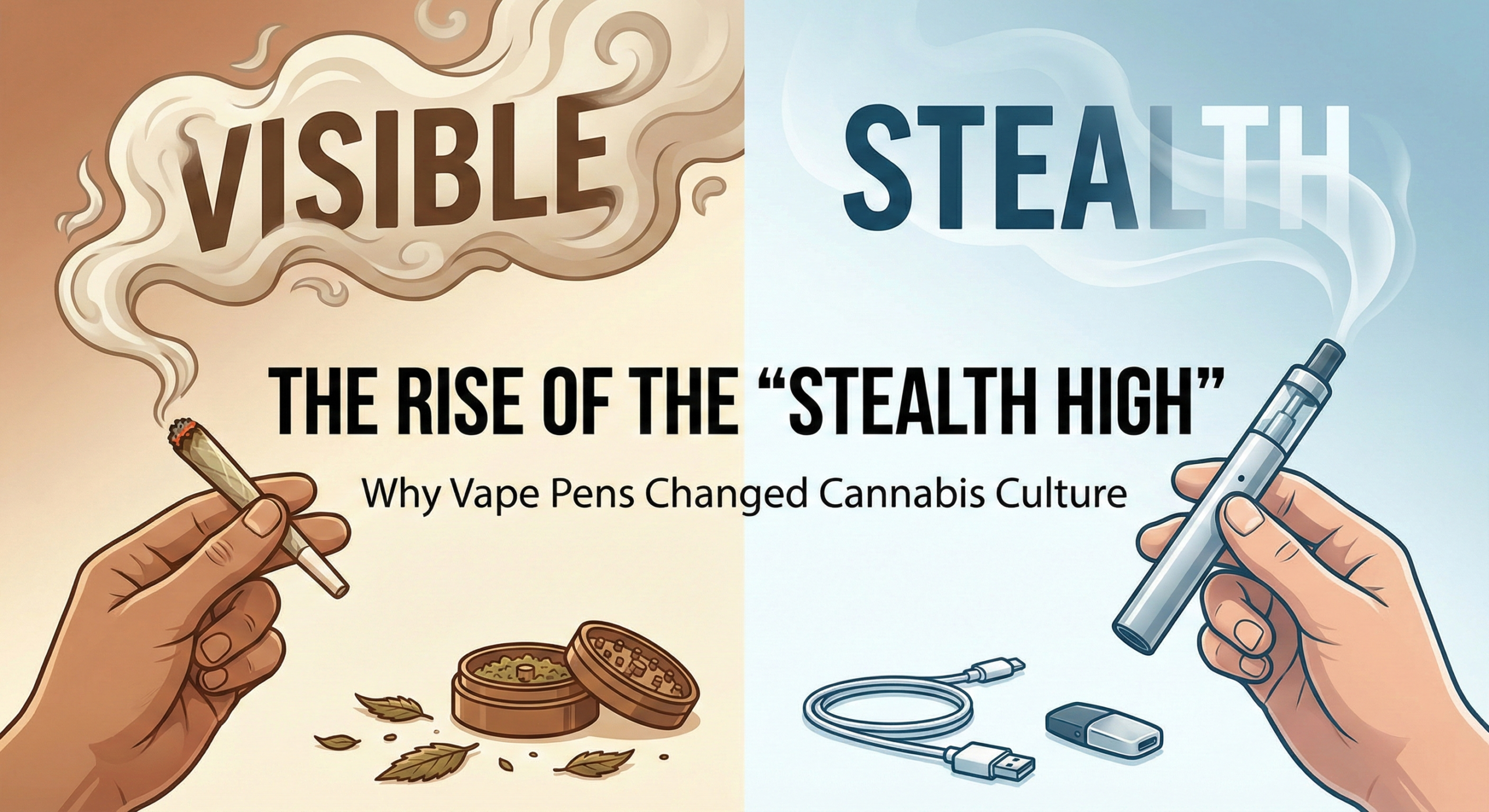
There was a time when cannabis announced itself. It did so loudly and unmistakably, through the sweet, skunky scent that clung to clothes, the visible curl of smoke, the ritual of grinding and rolling that took time and space. To use cannabis was to signal it — to others, and to oneself.
Today, much of that signalling has disappeared.
A person takes a small inhale while standing outside an office building, or on a train platform, or in the corner of a bar terrace. There is no lighter, no plume of smoke, no lingering smell. Nothing marks the moment as cannabis use at all. A few seconds later, the device is back in a pocket, and the person returns to their life unchanged in appearance, unmarked by evidence.
This is the stealth high. And it has quietly reshaped cannabis culture.
Historically, cannabis was a social act that left traces. Smoke drifted. Smell lingered. Rolling required surfaces, tools, time. These elements created friction, but they also created meaning. Cannabis use was rarely invisible, even when it was private.
That visibility came with consequences. It invited judgement, enforcement, and stigma. But it also produced recognition. To smoke was to step briefly outside the mainstream, even in places where cannabis was tolerated rather than embraced.
Vape pens remove most of these signals. They produce vapour instead of smoke, often lightly scented or barely perceptible. They are small, quick, and self-contained. Their design eliminates the outward markers that once defined cannabis consumption.
What emerges is not just discretion, but near-invisibility. Cannabis use no longer needs to announce itself in public space. It can occur without asking for permission, or forgiveness.
Discretion is often framed as convenience, but culturally it functions as power. The ability to remain unseen allows people to move freely through environments that might otherwise be hostile or judgmental.
In much of Europe, where cannabis exists in legal grey zones or under partial tolerance, this matters. The stealth high enables participation without confrontation. It allows users to remain aligned with social expectations rather than visibly challenging them.
This shift does not merely change behaviour; it changes identity. Cannabis becomes something one does, not something one is seen doing. The user no longer has to negotiate space with others in the same way. There is no smell to apologise for, no smoke to contain, no ritual to justify.
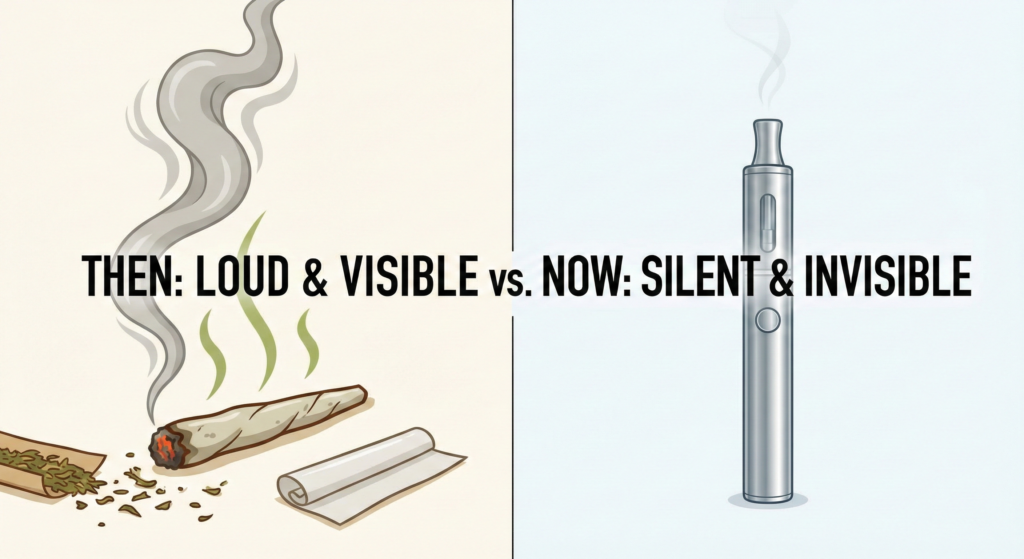
Cannabis slips quietly into ordinary life.
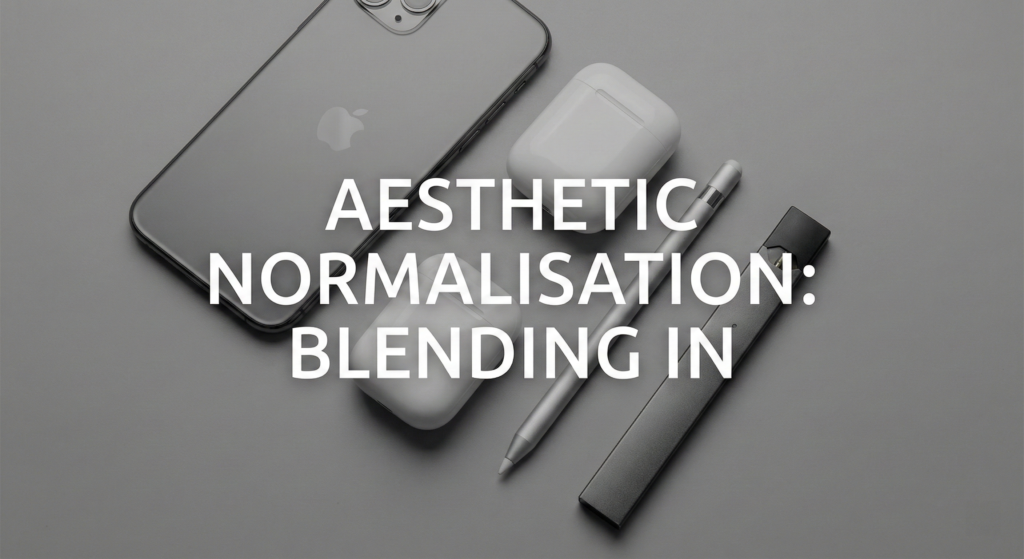
The cultural impact of vape pens is inseparable from their design. Unlike traditional paraphernalia, they do not borrow their aesthetic from counterculture. Instead, they resemble consumer electronics. Minimalist. Neutral. Intentionally unremarkable.
This is not accidental. Objects that look familiar are trusted. Objects that look ordinary are tolerated. A slim metal device with a charging port does not trigger the same reactions as rolling papers or a grinder.
In this way, vape pens participate in normalisation not through argument or activism, but through appearance. They do not ask to be accepted. They simply blend in.
Normalisation, here, is quiet and aesthetic rather than ideological.
As visibility decreases, cannabis finds access to spaces it once struggled to occupy. Office workers step outside during breaks without carrying the scent back inside. Travellers carry vape pens with less anxiety than flower. In nightlife settings, cannabis sits alongside alcohol rather than being pushed to the margins.
This is not necessarily about legality. It is about social compatibility. Vape pens make cannabis feel less disruptive, less demanding of accommodation.
The substance has not changed. The context has.
Cannabis becomes something that can coexist with responsibility, routine, and professional life. It no longer requires a separate environment or moment set aside for it. It integrates into existing rhythms.
Yet something is lost in this transition.
Traditional cannabis use was slow. It involved preparation, anticipation, and often sharing. Rolling a joint was an act that structured time. It invited conversation, pause, and collective attention. The ritual mattered as much as the intoxication.
Vape pens collapse this process. There is no preparation, no communal object, no defined beginning or end. Consumption becomes instantaneous and individual.
Cannabis becomes efficient, but less ceremonial.
For some, this is liberation. For others, it is a subtle hollowing-out of meaning. The experience becomes sharper, but also more fleeting. The high arrives without the grounding context that once framed it.
The stealth high feels different internally as well as socially. Without ritual or sensory markers, the transition into intoxication can feel abrupt. There is less time to adjust, to orient oneself.
Some users describe this as clarity and control. Others experience it as dislocation. The high appears suddenly, without ceremony, and disappears just as quietly.
Because the experience leaves no trace, it can feel unanchored from memory. Moments blur. The act of consumption is easily forgotten, even as its effects linger.
In this way, discretion changes not only how cannabis is perceived by others, but how it is perceived by the self.

Discretion does not operate equally across society. The ability to remain invisible is more valuable — and more available — to those already embedded in professional, secure environments.
The stealth high allows cannabis use to persist without forcing a reckoning with stigma. It protects some users while leaving broader cultural assumptions intact. Acceptance is achieved not by openness, but by concealment.
This raises a quiet tension. Cannabis becomes more normal by becoming less visible. The culture shifts without necessarily confronting its own discomfort.
Vape pens did not revolutionise cannabis culture through rebellion or spectacle. They did so through subtlety. By removing smoke, smell, and ritual, they allowed cannabis to slip into modern life unnoticed.
Whether this represents progress or loss depends on perspective. What is clear is that cannabis no longer needs to announce itself to exist.
The stealth high is not loud. It does not ask for attention. It leaves no trace.
And in doing so, it may have changed cannabis culture more profoundly than any protest or policy ever did.