
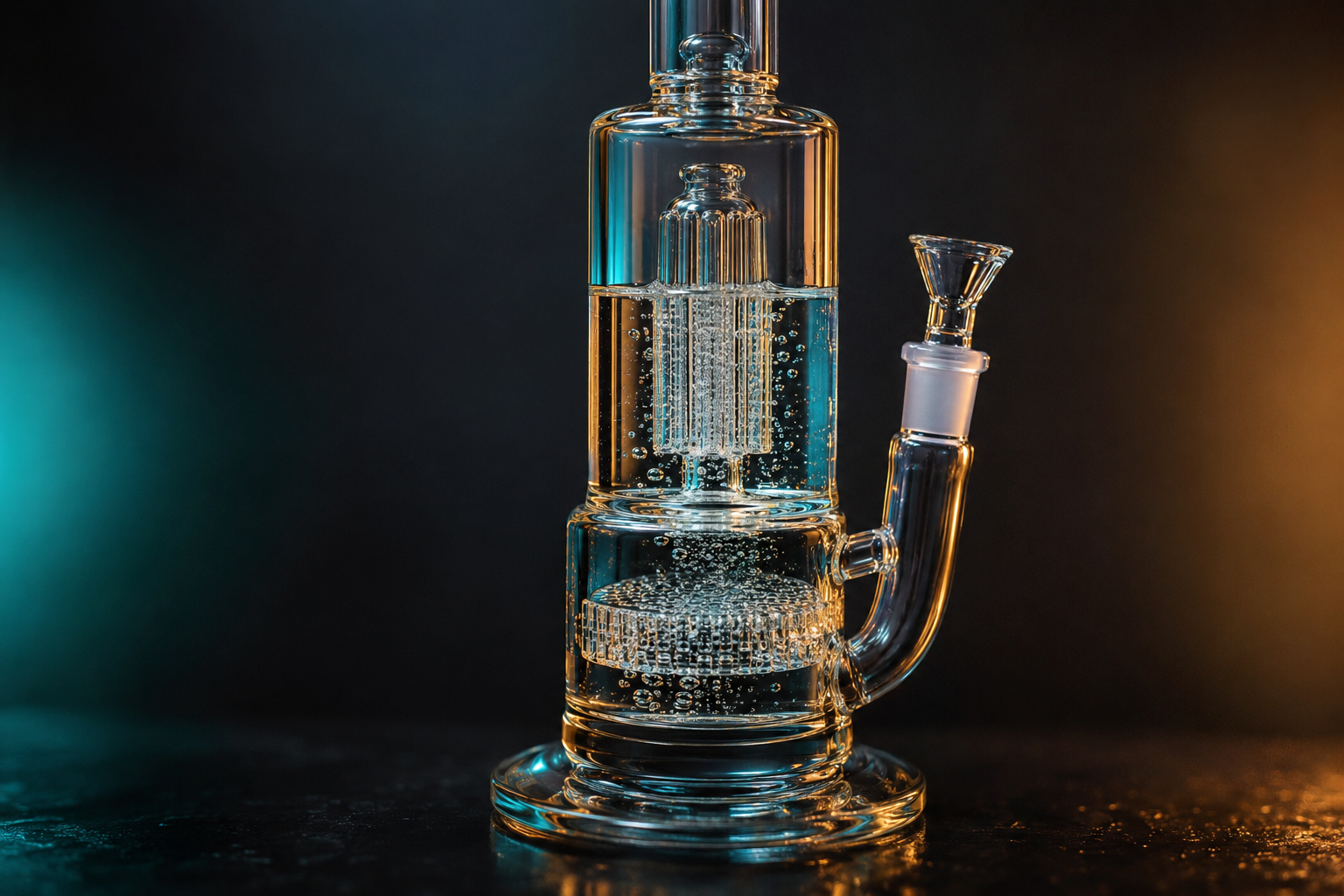
If you’ve ever peered into a proper percolator bong and thought, “why does this thing look like it was designed by a mad scientist who moonlights as a plumber,” you’re not far off. The percolator — or “perc,” as anyone who’s spent five minutes in a headshop will call it — is one of those bits of glassware that manages to be both wildly over-engineered and genuinely useful. And lately, it’s been quietly muscling its way into a scene it wasn’t originally built for: vaping THC oils and concentrates.
Let’s unpack the madness.
First, what actually is a percolator?
A standard bong does one job. Smoke goes down, bubbles through water, comes back up cooler and a touch smoother. Simple. A percolator takes that idea and, frankly, gets a bit greedy about it. It’s an extra chamber (sometimes two, sometimes an absurd stack of them) that forces the smoke or vapor to break up into loads of tiny bubbles before it ever reaches your lungs.
More bubbles mean more surface area. More surface area means more contact with the water. And more contact means better cooling and filtration. The whole thing works on the same principle as tossing a fizzy drink versus letting it sit flat — you’re maximising the interaction between gas and liquid. Except here, instead of ruining a perfectly good soda, you’re producing a smoother, cooler, distinctly less cough-inducing hit.
Percs come in a genuinely silly number of shapes, and each one has its own tiny fan club. Tree percs look like little upside-down chandeliers with slits cut into each arm. Honeycomb percs are flat discs drilled with dozens of holes that produce a satisfying rush of micro-bubbles. Showerhead percs do exactly what the name suggests. Then there are inline percs, matrix percs, turbine percs (which spin the water into a little vortex, purely because it looks cool and someone decided that mattered), and fritted disc percs, which are so fine they turn your water into what can only be described as an angry fog.
Is all of this necessary? Absolutely not. Is it delightful? Completely. The glassblowing world discovered a long time ago that people will happily pay extra for bubbles that look nice, and honestly, who can blame them. If you want to see just how far this rabbit hole goes, a browse through a dedicated range of percolator bongs will show you everything from single honeycomb discs to multi-stage builds that look like they belong in a laboratory.
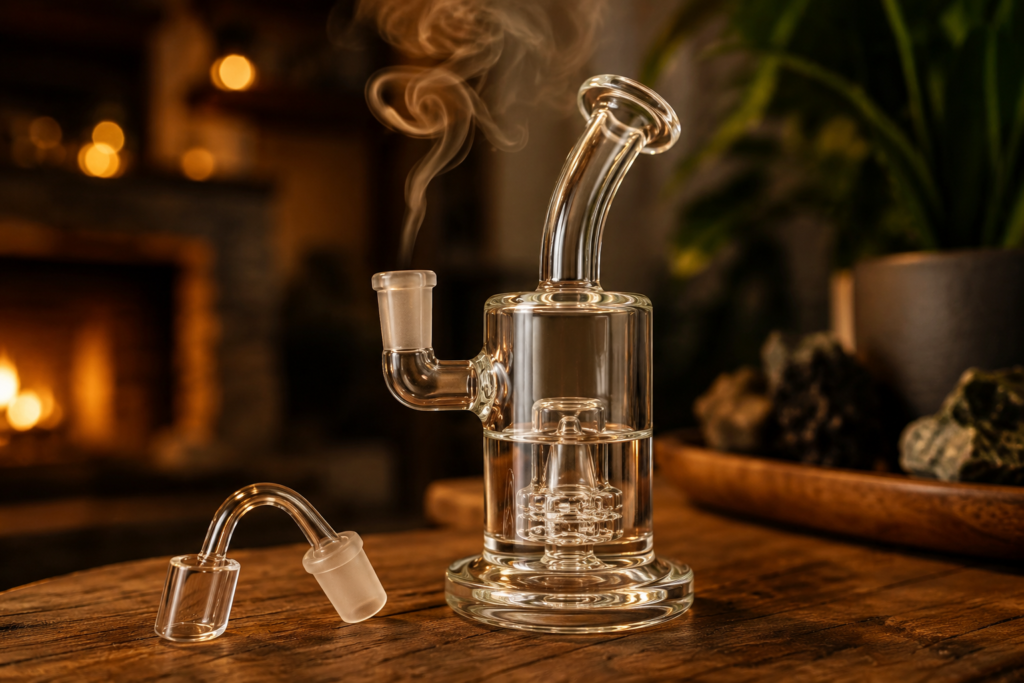
So why are people running THC oils through these things?
Here’s where it gets interesting. Percolator bongs were born in the flower era — dry herb, a bowl, a lighter, job done. But the cannabis world has drifted steadily toward concentrates: waxes, shatters, live resins, and various THC oils that pack a considerably bigger punch than a bowl of buds. And the humble perc turned out to be surprisingly well suited to the new job.
The main reason is heat. Vaporising concentrates — whether you’re using a dab rig, an e-nail, or a heated banger — tends to produce vapor that’s hotter and more intense than your average lungful of flower smoke. Take a dab that’s a fraction too hot and you’ll know about it, usually via a coughing fit that makes your neighbours think something’s gone badly wrong. Percolation cools that vapor down dramatically before it hits you. Those thousands of tiny bubbles pull the temperature down fast, turning a potentially brutal hit into something almost gentle.
There’s also the small matter of potency. Concentrates are strong — often three or four times the strength of flower. A smoother delivery system makes those big hits more manageable, especially for people who value the flavour and the effect but would rather not feel like they’ve inhaled a small campfire. The water filtration also scrubs out some of the harshness, letting the actual character of the oil come through.
In fact, most modern dab rigs are percolator bongs — just shrunk down and rebranded for the concentrate crowd. Same principle, smaller footprint, usually a fancier price tag.
The plot twist nobody warns you about
Now, before you go stacking seven percs onto one rig and calling it a day, there’s a catch, and it’s a genuinely important one for anyone working with quality THC oils.
Too much percolation can murder your flavour.
The terpenes — the aromatic compounds that give a good concentrate its lemon, pine, diesel, or gassy character — are delicate little things, and they don’t love excessive contact with water.
Research into cannabis vaping aerosols shows just how much these volatile compounds shape both the flavour and the way the active ingredients actually reach you, which is exactly why treating them gently matters.
Run your vapor through a towering, multi-chamber percolation monster and you’ll cool it beautifully, but you may also strip out a chunk of the flavour you paid good money for. It’s the concentrate equivalent of ordering a rare steak and then microwaving it “just to be safe.”
This is exactly why serious concentrate enthusiasts often go the opposite way from the flower crowd. Instead of maximalist glass sculptures, they gravitate toward smaller rigs with a single, modest perc and less water.
Just enough diffusion to take the edge off the heat, not so much that the terpenes drown on the way up. It’s a balancing act: cool enough to be comfortable, restrained enough to keep the good stuff intact.
The takeaway
The percolator bong is a bit of an accidental hero. It was designed to smooth out smoke, and it happened to be exactly the right tool for taming the hotter, punchier world of THC oils and concentrates. The bubbles cool things down, the water filters out the harshness, and the whole experience becomes something you can actually savour rather than merely survive.
The trick is knowing when to rein it in. A single well-chosen perc will make your oil smoother and kinder without sacrificing the flavour. An absurd tower of nine chambers will look magnificent on a shelf and quietly flatten everything that made your concentrate worth buying.
So by all means, appreciate the mad-scientist glasswork. Enjoy the turbine that spins for no practical reason. Just remember that when it comes to THC oils, a little percolation goes a long way — and sometimes the least dramatic bit of glass on the shelf is the one that treats your terpenes with the respect they deserve.